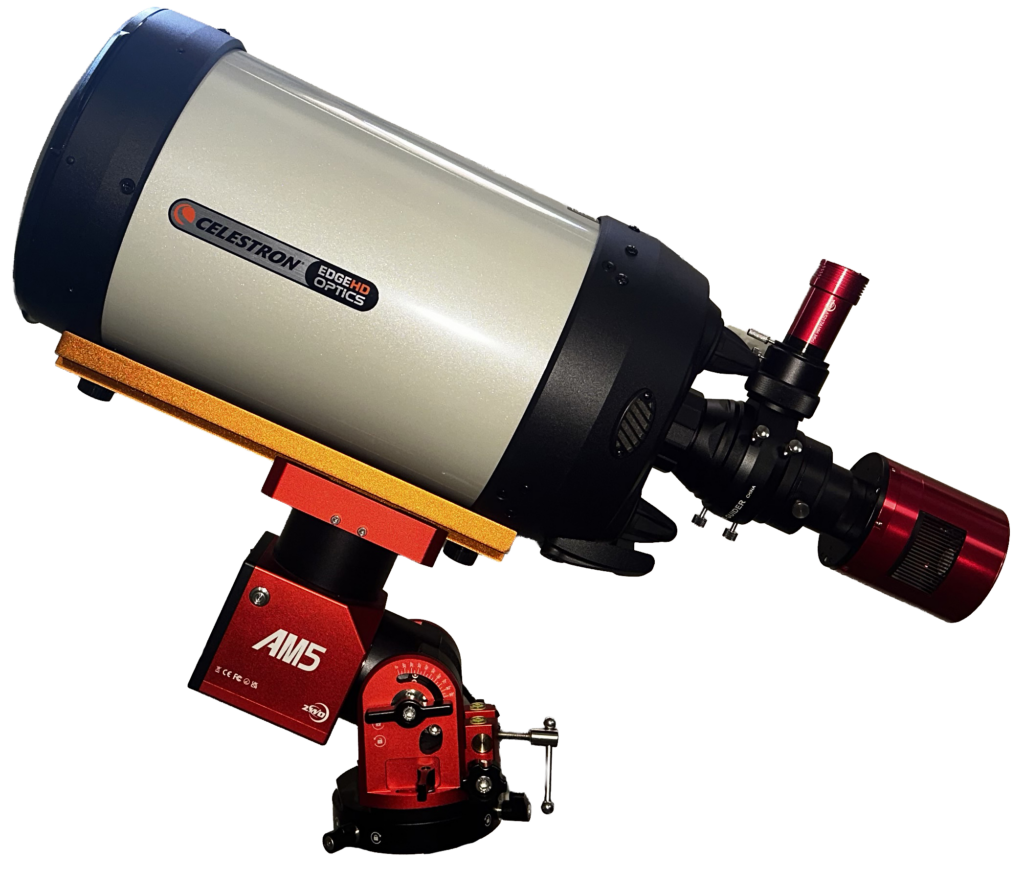
This image marks first light with my new telescope, the Celestron EdgeHD 800, an 8-inch Schmidt-Cassegrain designed for longer focal length imaging.
With a native focal length of 2000mm, and about 1422mm using a 0.7x reducer, this setup operates in a very different range than my previous Redcat 61 telescope (300mm). It’s built to resolve smaller targets with higher precision, using a flat-field optical design that keeps stars sharp across the entire frame. It also gathers over 2.5x more light than a typical 60mm refractor, which becomes noticeable when working on faint structure.
Not Just Zooming In
This wasn’t my first time imaging the Whirlpool Galaxy. My earlier image (below) was taken with a RedCat 61 at around 300mm focal length. At that scale, the galaxy obvious but small and blurry. You see the overall spiral shape, the companion galaxy, and the sense that something is happening between them. It’s a very zoomed in sample of the wide-field view.
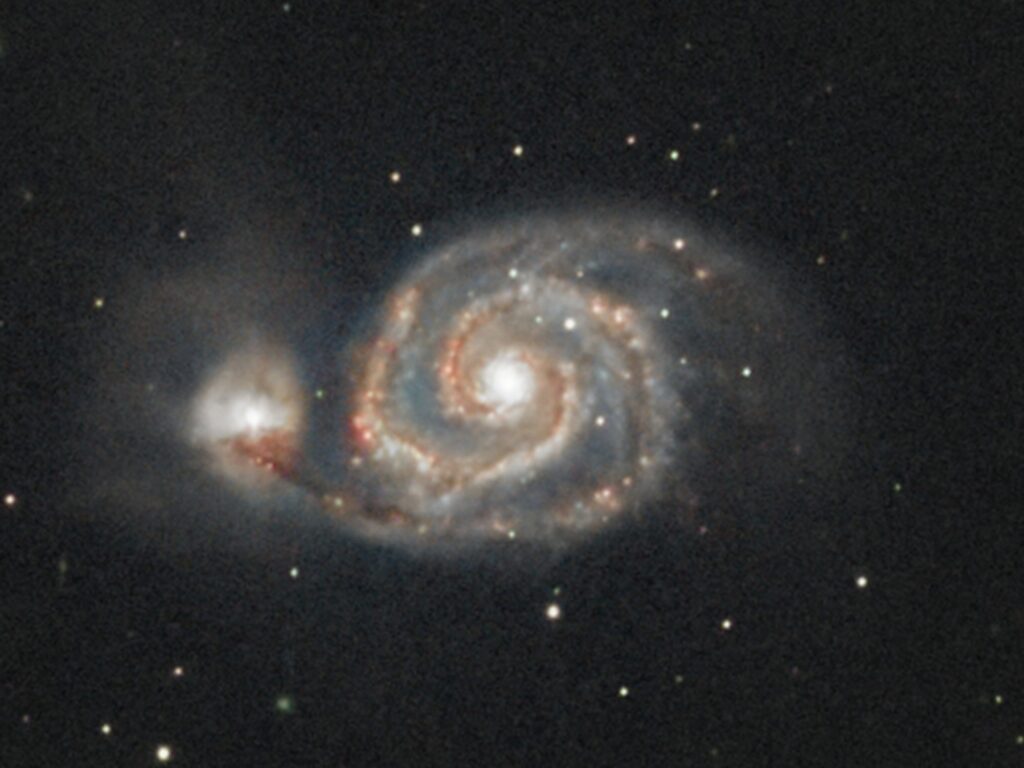
M51 taken in 2024 with my Redcat 61
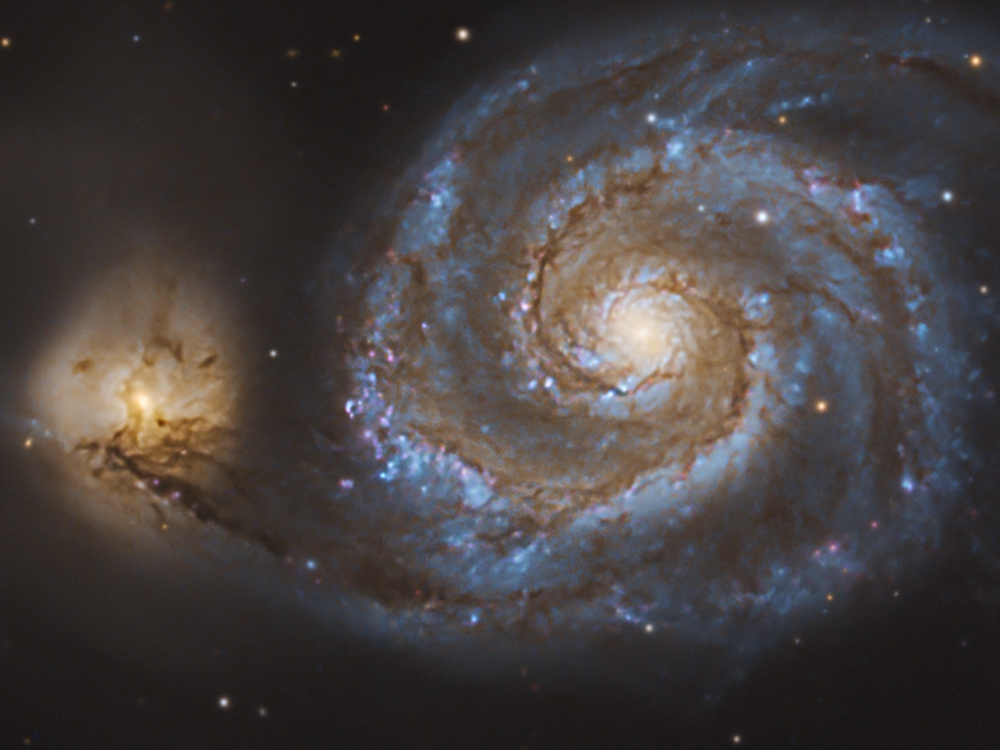
With my new EdgeHD 8” and reducer at about 1422mm, the galaxy fills much more of the frame, revealing detail that wasn’t visible before. It might seem like simple magnification, but it’s really about resolving finer structure.
Now the spiral arms aren’t just visible, they’re resolved. Dust lanes begin to cut through the structure. Bright star-forming regions show up as distinct knots instead of blended patches. The bridge of material connecting M51 to NGC 5195 becomes more obvious, making the interaction easier to see.
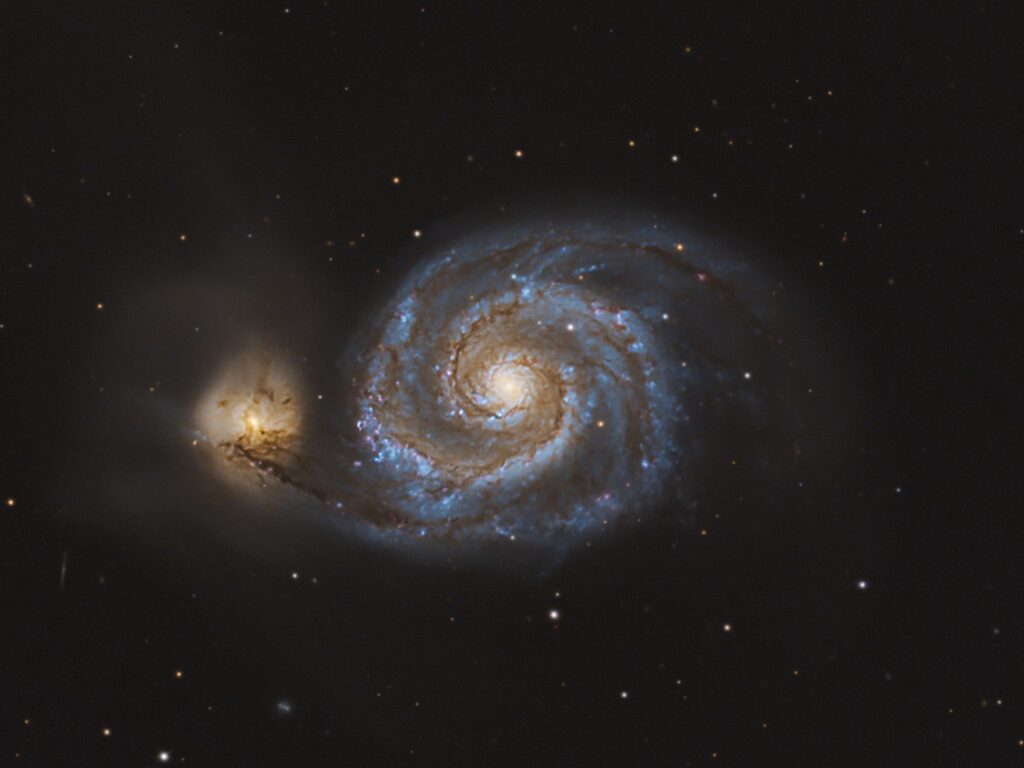
New image with Edge HD 8
What the Telescope Change Actually Did
Switching from a small refractor to a longer focal length reflector changes what you can extract from a target like this.
The RedCat 61 excels at wide frame imaging. It captures the scene cleanly and efficiently, especially under less-than-perfect conditions. But it doesn’t have the reach to pull out fine structure in smaller galaxies.
The EdgeHD 8” operates in a different range. At over 1400mm, it demands more from tracking, focus, and seeing, but the payoff is immediate. Structure becomes separation. Texture replaces blur. The galaxy starts to break down into individual features rather than appearing as a single object.
With this setup, targets that were previously too small to resolve well are now within reach. That opens the door to more galaxy imaging, revisiting past targets with greater detail, and even some planetary work down the line.
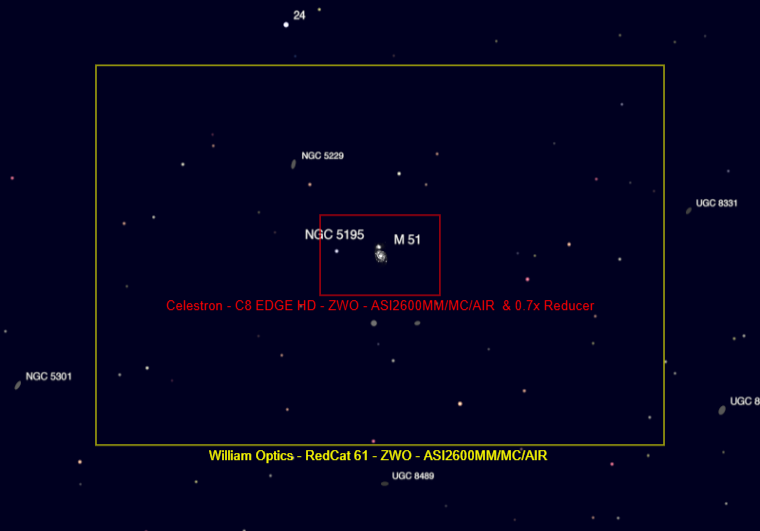
_Caption: *Field of view comparison between my two telescopes. Red is the new telescope.
Sky chart generated using Astronomy.Tools Field of View Calculator*_
The Whirlpool Galaxy
The Whirlpool Galaxy (M51) stands out among galaxies for its clearly visible spiral structure and its interaction with a nearby companion galaxy.
Located about 23 million light-years away in the constellation Canes Venatici, sitting just above the asterism of the Big Dipper’s handle, it was first recorded by Charles Messier in 1773. Two sweeping arms wrap around a bright core, with a smaller companion galaxy, NGC 5195, hanging just off one side and gravitationally tugging at those arms.
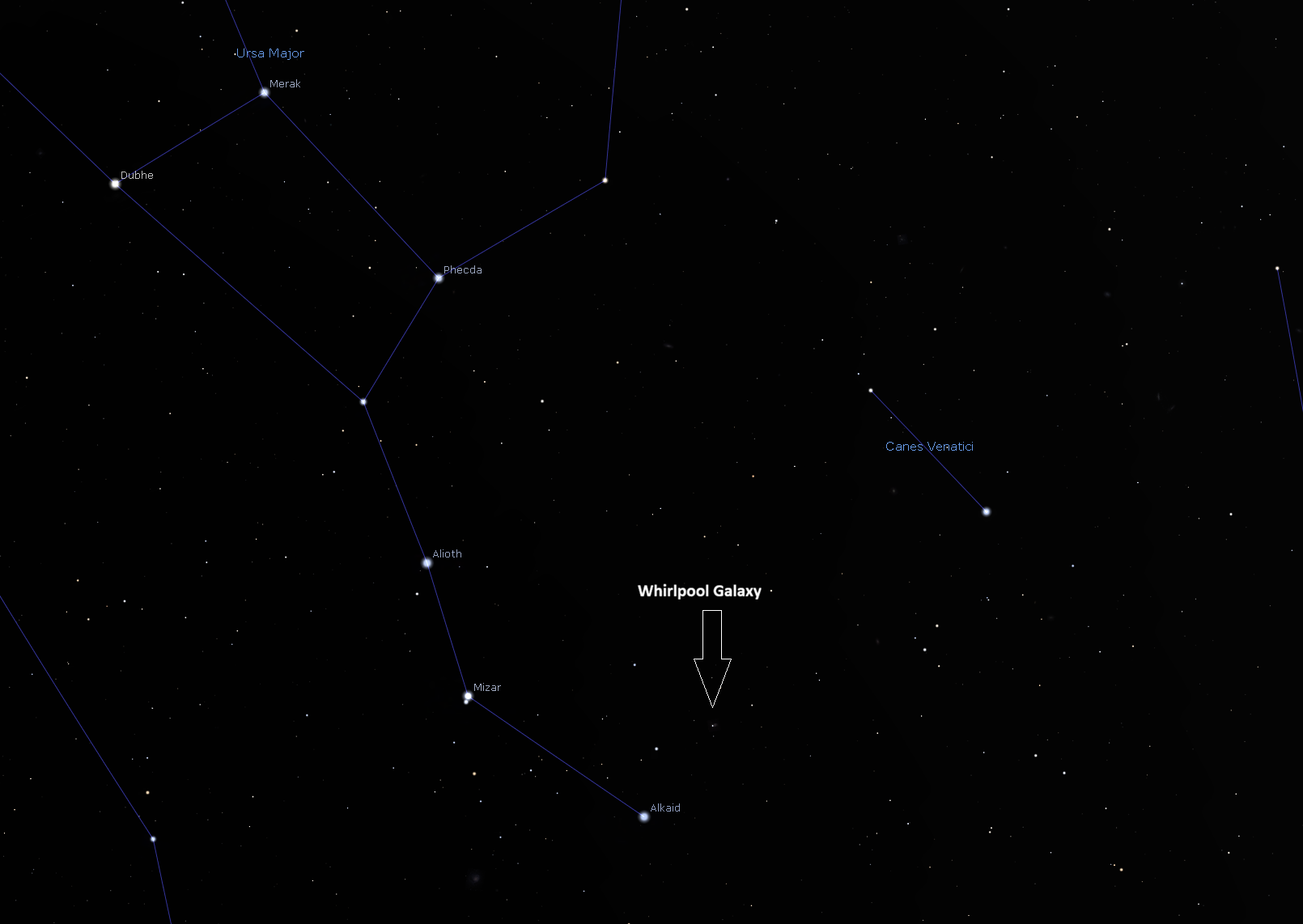
Sky map generated using Stellarium
What Gives M51 Its Structure
M51’s shape comes from its ongoing interaction with NGC 5195. As the smaller galaxy moves around it, it pulls on the stars and gas, organizing them into the spiral pattern we see.
Those arms aren’t fixed structures. They’re regions of compression moving through the galaxy, where gas gets squeezed and new stars form.
The bluish regions scattered along the arms are clusters of young, hot stars. The reddish patches are hydrogen gas clouds, known as HII regions, where new stars are actively forming. Across the image, you’re seeing different stages of stellar evolution playing out over tens of thousands of light-years.
Plenty of new images to come with the new telescope!